Neonatal Haddad Syndrome-Combined Congenital Central Hypoventilation Syndrome or Ondine’s Curse and Hirschsprung’s Disease
* Patel RV;
Zaparackaite I;
Singh H;
Singh SJ;
Swamy KB;
Midha PK;
-
* Patel RV: Department of Pediatric Surgery, PGICHR and KTCGUH, Rajkot, Gujarat 360001, India
-
Zaparackaite I: Department of Pediatric Surgery, Emergency’s Children’s Hospital, Entebbe/Evelina Children’s Hospital, London
-
Singh H: Department of Pediatric Surgery, PGICHR and KTCGUH, Rajkot, Gujarat 360001, India
-
Singh SJ: Department of Pediatric Surgery, Nottingham University Hospitals, Nottingham, UK
-
Swamy KB: Lincoln University College, Lincoln University, Kuala Lumpur, Malaysia
-
Midha PK: J. Watumull Global Hospital & Research Centre, Delwara Road, Mount Abu, Rajasthan, India; affiliated with the Medical Faculty, God Fatherly World Spiritual University, Rajasthan, India
Abstract
We wish to present a case report of a rare congenital disorder. The manuscript details the clinical course and management of a female term neonate with Haddad syndrome, which is the association of Congenital Central Hypoventilation Syndrome (CCHS), also known as Ondine’s curse, and Hirschsprung’s disease (HD). The case is notable because the association of these two conditions is rare and often poses diagnostic and management challenges in newborns. We outline the patient’s presentation with respiratory distress and bowel obstruction at birth and describe the diagnostic process, which included biochemical screening, imaging, and genetic testing, ultimately revealing a PHOX2B gene mutation, which is often the cause of CCHS. The patient’s management involved mechanical ventilation, as CCHS is characterized by autonomic nervous system failure to regulate breathing, particularly during sleep. The surgical management of Hirschsprung’s disease, which involves the absence of nerve cells in a part of the intestine, is also described in detail. We conclude that the co-occurrence of these diseases creates a complex situation that requires specialized care and long-term commitment. Our case presents a compelling and rare case, making it potentially interesting to a readership of pediatric and neonatal medicine professionals.
Introduction
Haddad syndrome is a rare, potentially fatal, genetic disorder combining Congenital Central Hypoventilation Syndrome (CCHS), or Ondine’s curse, with Hirschsprung’s disease. It stems from genetic mutations, most often in the PHOX2B gene, which affect the development of neural crest cells. The disorder leads to a failure of the body’s automatic control of breathing, bowel function, and heart rate. We have seen a frequent association of Hirschsprung’s disease with twins, abdominal wall defects including gastroschisis and exomphalos, gut atresias especially colonic atresias, severe cardiac anomalies, and Trisomy 21, but not with the congenital central hypoventilation syndrome (CCHS), to emphasize the rarity of the case [1–5]. CCHS is a very rare and uncommon cause of apnea in the newborn, predominantly during sleep. We wish to present such a case of Haddad syndrome recently managed by us, which was first described by Haddad et al. [6–7].
Case Presentation
A female term neonate weighing 2960 g was born to a primigravida mother after an eventful prenatal scan, pregnancy, and normal spontaneous vaginal delivery. Biochemical screening for Down’s syndrome was reported as low risk, and 20-week fetal anomaly scanning failed to reveal any major abnormality. The neonate had low Apgar scores of 8, 6, and 5 and developed respiratory distress at birth, requiring endotracheal intubation and mechanical ventilation. The neonateThe neonate developed abdominal distension and had not passed meconium despite a normally sited and normally sized patent anus.
The laboratory investigations were all within normal limits. Ultrasound scans of the abdomen, pelvis, spine and brain were within normal limits. Electrocardiogram and echocardiography showed no abnormalities with normal vascularity and vasculature of main vessels of the heart and lungs.
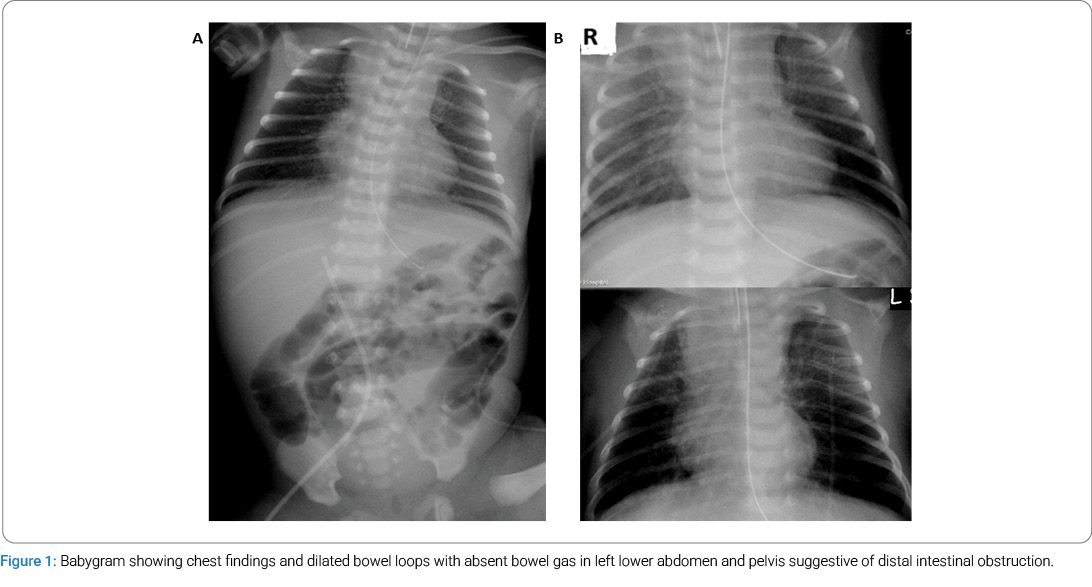
The babygram (radiographs of the chest and abdomen) showed the feeding tube tip of the feeding tube in the left upper quadrant, the tip of the endotracheal tube at T-1 level, above the carina, and the tip of the umbilical venous catheter just to the right of midline at T-11 level. The heart, diaphragms and pleural spaces were normal. There was a slight haze throughout both lungs suggesting mild surfactant deficiency. There was gaseous distension of bowel loops with absent bowel gas in the left lower abdomen and pelvis, suggesting distal intestinal obstruction syndrome (Figure 1A). The patient developed upper lobe consolidation, which was treated effectively (Figure 1B).
The patient initially responded to suppositories and saline bowel washouts, and tube feeding with expressed breast milk was established. However, despite surfactant therapy, repeated attempts at weaning from ventilation failed. Genetic counseling is crucial for families, as the condition is autosomal dominant with variable penetrance; comprehensive assessments of autonomic nervous system function (cardiovascular, digestive, ocular) and a Brain MRI to rule out other conditions. The genetic tests revealed mutations in the PHOX2B gene. Specific tests included sequencing of the entire PHOX2B coding region or mutation scanning of select exons to identify changes, such as Polyalanine Repeat Expansion Mutations (PARMs). Other genetic tests, such as deletion/duplication analysis, may also be used to detect larger genetic changes, which were not performed in our case.
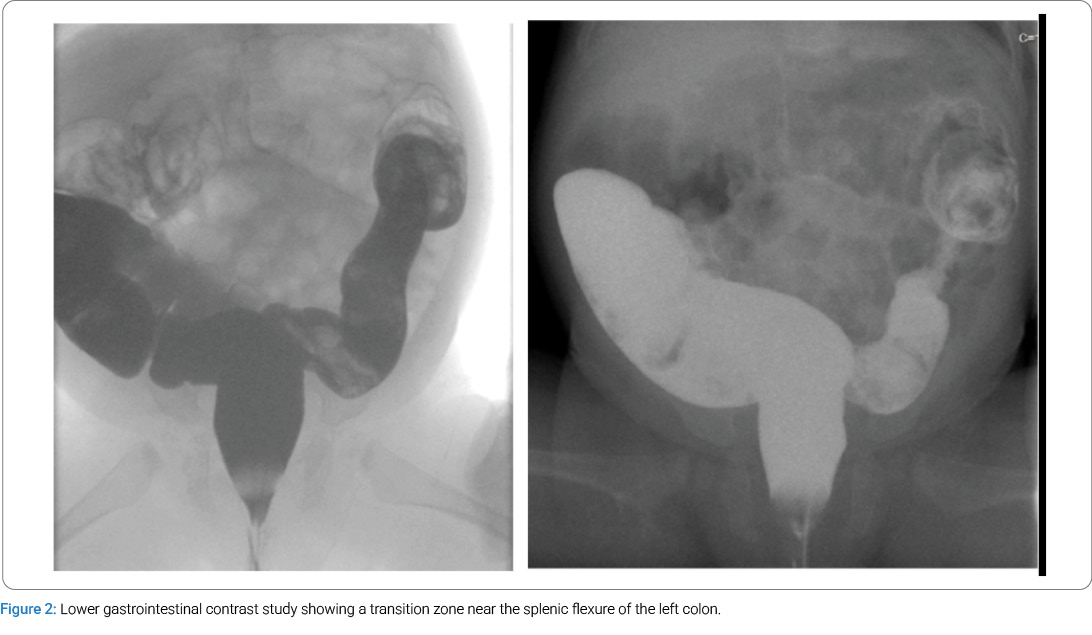
Recurrent abdominal distension, poor tolerance of tube feeds, aspiration pneumonia, and poor response to suppositories and bowel washout led to a lower gastrointestinal contrast enema, which demonstrated a long segment of left colonic Hirschsprung’s disease with a transition zone near the splenic flexure (Figure 2). Water-soluble contrast was instilled via rectal catheter in situ. Early filling of the rectum and sigmoid demonstrated an abnormal rectosigmoid ratio; the rectum was narrow in caliber compared with the sigmoid colon. No convincing evidence of persistent sawtooth irregularity was noted. The descending colon lumen was smaller than the transverse colon with a transition zone at the splenic flexure. The transverse colon was distended by air with some minor contrast opacification. There were a few narrow segments in the sigmoid and descending colon in keeping with spasm. It was concluded that, given the history of aganglionic rectal biopsy, abnormal rectosigmoid ratio, and smaller lumen diameter of the descending colon than transverse colon with transition zone at the splenic flexure. Rectal suction biopsy confirmed it to be Hirschsprung’s disease. Patient underwent laparoscopic multiple extramucosal seromuscular biopsies, which revealed long-segment left colonic disease, and a leveling left transverse colostomy was performed.
The patient remained clinically stable but experienced endotracheal tube displacement and airway management difficulties, so at 6 weeks of age, a tracheostomy was performed uneventfully. At 3 months of age, an inpatient Video-Fluoroscopic Swallow Study (VFSS) was trialed with thin liquid via syringe in a bolus size of 0.3 mL–0.5 mL, showing liquid pooling in the anterior sulcus with piecemeal deglutition in the oral phase. In the pharyngeal phase, no penetration/aspiration for minimal volumes trialed; however, swallow triggered at pyriform with 0.5 mL and several swallows per bolus required. Therefore, the recommended plan for swallow practice was with stage 1 (syrup/1:90 mL) in bolus size 0.5 mL via syringe, paced, with use of dummy to facilitate oral phase.
Repeat VFSS at 6 months assessed with stage 2, custard consistency liquid (1:60 mL) via bottle. Suck/swallow ratio averaged at 3–4 sucks per swallow with marked nasopharyngeal reflux. Swallow triggered at level of vallecula/leaving vallecula; however, at times, it was triggered at pyriform sinus. No penetration/aspiration was recorded. Oropharyngeal phase was consistent with the diagnosis of congenital hypotonia exemplified by suck/swallow ratio and velopharyngeal insufficiency. Current anatomical protection needed to be replaced by neuromuscular movement, and Feeding should proceed cautiously with close monitoring of respiratory health over time. Recommendation and action plan included the further assessment of the palate, continued stage 2 custard-consistency liquid via bottle with careful pacing and 30-degree angle positioning, consideration of weaning to liquid via open cup, and introduction of puree via spoon.
Patient underwent exploratory laparotomy combined with trans anal modified Soave’s pull-through procedure after excision of left colon and mobilizing right colon and mobilising and rotating the left transverse ganglionic colon based on the marginal artery and middle colic and superior mesenteric vessels with a coloanal anastomosis and internal anal sphincterotomy uneventfully. The postoperative recovery was smooth. The patient is currently more than 1 year old and is requiring positive pressure ventilation overnight in the high dependency unit and thriving well.
Discussion
CCHS primarily affects the failure of the autonomic nervous system’s breathing control. At the same time, Hirschsprung’s disease (HD) impacts bowel function due to the absence of nerve cells in the intestinal wall, associated with nerve hypertrophy and increased acetylcholinesterase enzyme. CCHS is often associated with tumors of neural crest origin, HD, and other autonomic nervous system disorders, in affected children [8].
The parents were very surprised to hear the sad news that two major potentially life-threatening congenital anomalies had no prenatal indications of any grave congenital diseases, and communicating the diagnosis was challenging for the clinical team, as they expected that in this era of prenatal diagnosis and advanced technology at least some hints or suggestions in advance would have prepared them better or have taken an informed decision [1,3,5]. However, recently the unique sonographic findings of total colonic aganglionosis in a term neonate with Haddad syndrome have been reported [9]. It has been reported in extreme preterm babies, fetal arrhythmia, and trisomy 21 babies [10–12].
CCHS is characterized by the failure of the autonomic nervous system to regulate breathing, particularly during sleep. It may be associated with facial paralysis and other developmental issues. This rare disease requires lifelong management with mechanical ventilation, often at night, and can impact feeding due to acid reflux and decreased intestinal motility, as was seen in our case.Hirschsprung’s disease (HD) is a congenital condition where nerve cells are missing from parts of the intestine, usually the colon, preventing normal bowel movements. It may cause severe constipation, abdominal distention, and vomiting. HD can be diagnosed through various tests, including biopsies. Treatment typically involves surgery to remove the affected portion of the intestine. Haddad syndrome patients may present with a triad of feeding, breathing, and bowel motility problems. The severity of symptoms and the length of the aganglionic segment in Hirschsprung’s disease can vary [12].
The discussion of the feeding difficulties, including the Video-Fluoroscopic Swallow Studies (VFSS), is quite important in our case. However, the connection between the findings of velopharyngeal insufficiency and the broader diagnosis of congenital hypotonia can be more explicitly linked to the overarching pathology of Haddad syndrome. Novel neuropathologic findings in Haddad syndrome with brain anomalies have been reported [13]. The differential diagnosis of the syndromes associated with hypotonia and velopharyngeal insufficiency include in addition to Haddad syndrome include birth defects affecting the palate (roof of the mouth), such as cleft palate or an abnormally short palate. Enlarged tonsils or adenoids. Genetic conditions such as Down syndrome or neurofibromatosis, cerebral palsy, and congenital velopharyngeal incompetence [11].
The purpose of genetic counseling is to inform the family about the genetic basis of its autosomal dominant inheritance pattern and the implications for recurrence risks. Genetic counseling provides key information and guidance on the challenges of diagnosis due to overlapping symptoms and offers support for families of diagnosed individuals. It is essential and important for understanding the condition, making informed decisions about testing, and planning for prenatal or presymptomatic testing if the specific mutation has been identified [7].
A variety of comprehensive assessments at diagnosis include autonomic nervous system: covering cardiovascular, digestive, and ocular systems; neurodevelopment: and neurocognitive status of the patient; brain MRI: to confirm the diagnosis of CCHS and rule out other potential causes of central hypoventilation; neural crest tumor investigations such as neuroblastoma should be discussed, as these tumors are found in a significant percentage of CCHS cases depending on the patient’s age and genotype [8].
Genetic testing for PHOX2B mutations can aid in diagnosis and predicting disease progression. Genetic tests include PHOX2B gene testing, which is the main gene associated with Haddad syndrome and CCHS; Other types of tests include sequence analysis with an analysis of the entire coding region of the PHOX2B gene to identify small mutations; deletion/duplication analysis to detect larger deletions or duplications of genetic material within the gene. And mutation scanning of the selected exons of the gene for potential mutations [10].
An abnormality of neural crest development is believed to contribute and/or migration could result in this syndrome. Those neonates who survive can have widespread generalized autonomic nervous system dysfunction, and the prognosis should be well guarded.
The primary differential for Haddad syndrome involves conditions with Congenital Central Hypoventilation Syndrome (CCHS) alone, such as other primary neuromuscular (muscular dystrophy), pulmonary congenital pulmonary anomalies, or cardiac diseases (severe), or conditions causing generalized autonomic nervous system dysfunction like hypoxic-ischemic encephalopathy, severe prematurity, or other genetic syndromes causing similar symptoms. A confirmed diagnosis of Haddad syndrome requires genetic testing for a PHOX2B gene mutation and intestinal biopsies [6–13].
Conclusion
In conclusion, while both Congenital Central Hypoventilation Syndrome and Hirschsprung’s disease are relatively uncommon taken individually, when they occur together, they can create a complex situation requiring specialized care and long-term commitment for the parents, patients, professionals, politicians and public. Diagnosis and management of Haddad syndrome are very challenging, difficult, and demanding on the health care setting as the manifestations of failure to maintain breathing effort and failure to establish feeds overlap. Haddad syndrome requires specialized care and long-term commitment
Conflict of Interest
The authors declare no potential conflicts of interest with respect to the research, authorship, and/or publication of this article. Informed consent was obtained for this publication.
References
- Patel RV, Lawther S, McCallion WA. Discordant monozygotic total colonic Hirschsprung’s disease presenting with neonatal isolated ileal perforation. BMJ Case Rep. 2013;2013: bcr2013200743.
- Zaparackaite I, Singh SJ, Bhattacharya D, Swamy KB, Correia RC, Midha PK, et al. Innovative approaches to the surgical challenges in the management of gastroschisis: A narrative review of the literature. J Transl Gastroenterol. 2024;2(3):159–169.
- Correia RC, Balliari MD, Sardenberg AAF, Zaparackaite I, Swamy KB, Midha PK, et al. Neonatal giant exomphalos: A staged approach by external silo and DuoDERM dressing reductions followed by delayed primary repair. Discussion of Clinical Cases. 2023;10(4):4–8.
- Patel RV, Trambadia RA, Anthony FM, Chhaniara RA, Govani D, Patel RR, et al. Case series—Congenital neonatal colonic atresias arising in watershed areas of the colonic blood supply. Journal of the Indian Medical Association (JIMA). 2024;122(2):55–60.
- Trambadia RA, Anthony FM, Chhaniara RA, Govani DR, Correia RC, Patel RV. Hirschsprung- Associated recurrent enterocolitis in a case of trisomy 21 and atrioventricular septal defect. Front Infect Diseases Microbiol. 2022;2:110–113.
- Haddad GG, Mazza NM, Defendini R, Blanc WA, Driscoll JM, Epstein MA. et al. Congenital failure of automatic control of ventilation, gastrointestinal motility and heart rate. Medicine (Baltimore). 1978;57(6):517–526.
- Jaiyeola P, El-Metwally D, Viscardi R, Greene C, Woo H. Congenital hypoventilation syndrome and Hirschsprung’s disease – Haddad syndrome: A neonatal case presentation. J Neonatal Perinatal Med. 2015;8(2):165–168.
- Dejhalla M, Parton P, Golombek SG. Case report of Haddad syndrome in a newborn: congenital central hypoventilation syndrome and Hirschsprung’s disease. J Perinatol. 2006;26(4):259–260.
- Lim YJ, Jung HK. Sonographic findings of total colonic aganglionosis in a neonate with Haddad syndrome: A case report. J Clin Ultrasound. 2022;50(6):810–813.
- Bajaj R, Smith J, Trochet D, Pitkin J, Ouvrier R, Graf N, et al. Congenital Central Hypoventilation Syndrome and Hirschsprung’s Disease in an Extremely Preterm Infant. Pediatrics. 2005;115(6): e737–e738.
- Majumdar S, Wood PL. Congenital central hypoventilation syndrome (CCHS) with Hirschsprung disease (Haddad syndrome): An unusual cause of reduced baseline variability of the fetal heart rate. Journal of Obstetrics and Gynaecology. 2009;29 (2):152–153.
- Jones KL, Pivnick EK, Hines-Dowell S, Weese-Mayer DE, Berry-Kravis EM, Santiago T, et al. A Triple Threat: Down Syndrome, Congenital Central Hypoventilation Syndrome, and Hirschsprung Disease. Pediatrics. 2012;130(5):e1382–e1384.
- Tomycz ND, Haynes RL, Schmidt EF, Ackerson K, Kinney HC. Novel neuropathologic findings in the Haddad syndrome. Acta Neuropathol. 2010;119(2):261–269.
Cite this article
Zaparackaite I, Singh H, Singh SJ, Swamy KB, Midha PK, Patel RV. Neonatal Haddad Syndrome-Combined Congenital Central Hypoventilation Syndrome or Ondine’s Curse and Hirschsprung’s Disease. Clin Surg J. 2026;7(2):1–5.
Keywords
Autonomic nervous system; Bowel obstruction; Congenital anomalies; Congenital central hypoventilation syndrome; Haddad syndrome; Hirschsprung’s disease; Ondine curse; PHOX2B gene mutation; Respiratory distress
Copyright
© 2026 Ramnik V Patel. This is an open access article distributed under the terms of the Creative Commons Attribution 4.0 International License (CC BY-4.0).